From Manual Post-Sale Admin to a Structured Customer Operations Process
A growing service business needed a more consistent way to manage what happened after a sale. Information had to move across Sales, Client Success, Delivery and operational teams, but much of the process relied on manual emails, repeated updates, notes and separate reporting tasks.
I redesigned the post-sale process around a clearer operating model:
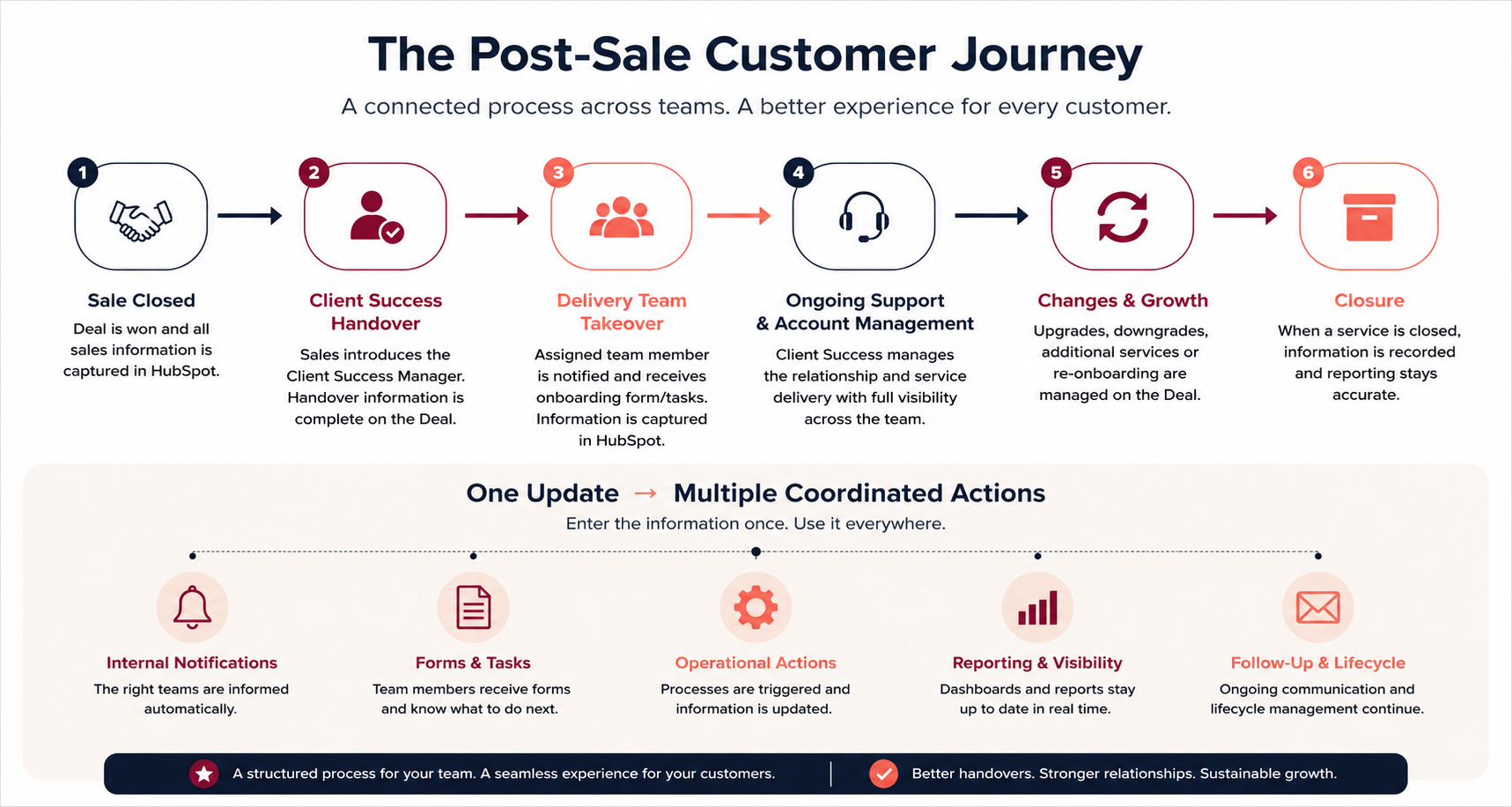
One update = multiple coordinated actions.
One customer journey = one connected process.
The project included Client Success process design, Deal-based handovers, workflow automation, internal notifications, onboarding forms, re-onboarding, upgrade and downgrade tracking, reporting logic, process documentation and team training.
Client Success · Workflow Automation · Customer Lifecycle · Handover Processes · Reporting · Operational Efficiency
After a sale was completed, information needed to move across Sales, Client Success, Delivery and operational teams.
Much of that process relied on people remembering to send emails, copy information, update notes, notify the right people and maintain reporting separately.
That created several risks:
- Missed handover steps
- Repeated data entry
- Inconsistent information
- Forgotten internal notifications
- Limited visibility across teams
- Fragmented customer history
The process also had to support more than initial onboarding. Clients could later add services, upgrade, downgrade, change assigned team members, re-onboard or close one service while others remained active.
The business needed a more professional and repeatable way to manage the post-sale customer journey without creating even more manual administration.
I redesigned the post-sale process around structured Deal data, custom properties, workflows, forms and internal notifications.
The solution created a structured post-sale operating model for Client Success and Delivery teams using the CRM tools already available, without requiring a separate Service Hub setup.
Instead of using HubSpot as another place where information had to be re-entered, the goal was to make the CRM the operational trigger point for what happened next.
A single update could support multiple coordinated actions across the business, including:
- Internal team notifications
- Handover actions
- Onboarding activity
- Follow-up tasks
- Operational updates
- Reporting changes
- Management visibility
The principle behind the process was simple:
Enter the information once. Use it everywhere.
This created a more connected operating model and reduced the reliance on manual emails, repeated CRM updates and separate reporting tasks.
Once Sales completed the relevant steps, the client could move into the Client Success process with the necessary commercial information already linked to the Deal.
The salesperson introduced the Client Success Manager to the client, creating a clear handover point between Sales and Client Success.
Client Success could then manage the service from the correct Deal rather than relying on disconnected Contact-level information or email history.
Delivery Team Takeover
Client Success updated the relevant Delivery Team Takeover information in HubSpot.
That update could trigger the next action for the assigned delivery team member.
The team member received the relevant notification or form and could confirm information such as:
- Whether they had connected with the client
- Whether setup was complete
- Whether they were ready to begin
- Any onboarding information required by the business
The responses could then be captured against the customer record, giving Client Success and operational teams better visibility without relying on separate email conversations.
One Update. Multiple Coordinated Actions.
A single CRM update could help trigger:
- Internal notifications
- Forms and tasks
- Operational actions
- Reporting updates
- Follow-up activity
- Lifecycle management
This reduced repeated data entry and helped make the handover process more consistent across teams.
The process continued beyond the initial sale and onboarding.
Each individual service could move through:
Sale → Onboarding → Delivery → Account Management → Re-onboarding → Upgrade / Downgrade → Closure
while the Contact remained the central customer record.
This was especially important when one customer had several services at the same time.
A change to one service could be managed against the correct Deal without incorrectly treating the entire customer relationship as lost.
Built for Customer Success Without Service Hub
The business needed a structured way for Client Success and operational teams to manage post-sale activity without relying on a separate Service Hub setup.
I used the CRM tools already available, including Deals, custom properties, workflows, forms and internal notifications, to create a professional and repeatable customer operations process.
This allowed the team to manage the customer lifecycle consistently while keeping commercial, operational and service information connected.
Re-onboarding & Retention
If a client was unhappy with an assigned team member, the business could attempt to retain the client by assigning someone new.
The re-onboarding process helped coordinate:
- The new team member
- Client Success
- Internal operational teams
- Customer communication
- Reporting
Instead of treating reassignment as an informal exception, it became part of the wider customer lifecycle process.
Upgrades, Downgrades & Service Changes
The Client Success structure also supported changes such as:
- Add-ons
- Upgrades
- Downgrades
- Changes in hours
- Changes in service value
- Changes in assigned team members
For downgrades, information such as Plan Downgrade Date, Variance Hours, Variance Value and Lifetime Downgrades could be tracked for reporting.
This gave the business better visibility into revenue movement and churn at service level.
The redesigned process created a much more connected post-sale operation.
It helped the business:
- Improve Sales-to-Client Success handovers
- Reduce repeated manual administration
- Standardise onboarding
- Keep operational information in one place
- Improve visibility across teams
- Support re-onboarding and retention
- Track upgrades and downgrades more accurately
- Improve service-level reporting
- Reduce reliance on memory and manual emails
- Create a more scalable post-sale process
The result was a more professional way for Client Success and operational teams to manage the customer journey using the systems already available to them.
I designed and implemented the Client Success handover and lifecycle process, translating operational needs across Sales, Client Success and Delivery into a connected CRM workflow.
My work included:
Client Success process design · Deal property design · CRM record structure · Workflow automation · Internal notifications · Handover forms · Delivery Team Takeover process · Re-onboarding processes · Upgrade and downgrade tracking · Reporting logic · Process documentation · Team training
The project combined CRM configuration with operational process design, with the goal of making the post-sale customer journey easier for teams to manage, easier to track and more consistent as the business grew.